
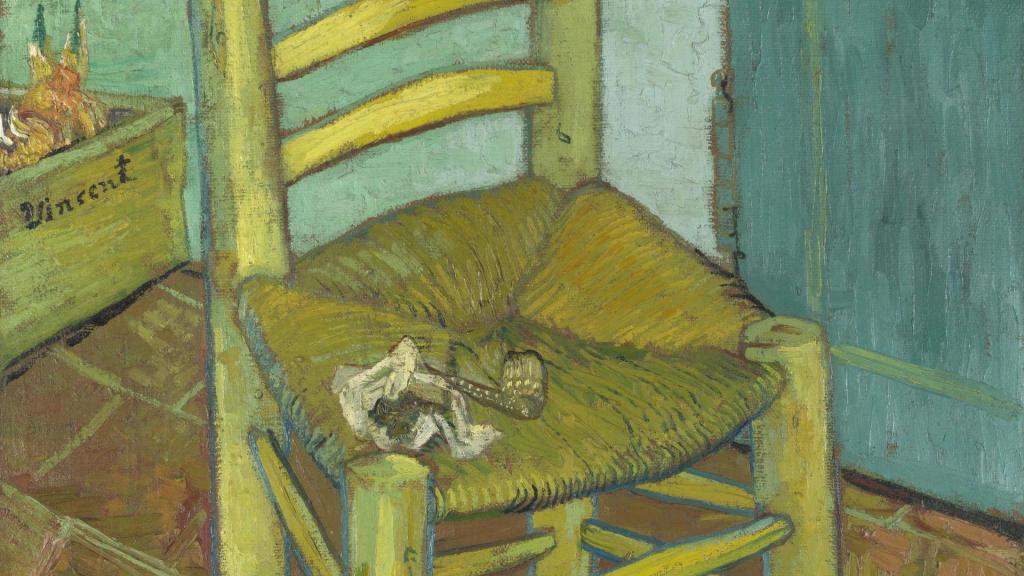
Van Gogh painted two companion paintings of chairs during his time in Arles. One was of his chair and the other of Gauguin’s chair. Gauguin had lived with Van Gogh in the Yellow House for nine weeks. These paintings are so rich in symbolic layers that they are better thought of as portraits portraying their contrasts in character. Gauguin’s Chair is currently on display here in the Van Gogh Museum, Amsterdam, but Van Gogh’s Chair is on Display at the National Gallery, London.
In Van Gogh’s Chair, he depicts a simple straw chair with a pipe resting upon it. The room is also quite plain, with only simple red tiles and a blue wall. In this painting, it is as though Van Gogh has replaced his straw hat with a straw chair to signal much of the same message: he saw himself in the same vein as peasant life. The clay pipe expands upon this image by representing the humble earth.
In Gauguin’s Chair, Van Gogh paints a much more ornate chair in dimly glowing light. The chair is finely carved, and much less practical than Van Gogh’s own. It even appears to be floating from the floor, a floor that is very rich in detail. The wall’s of the Yellow House were actually white, so the choice of a green wall was purposeful to create an air of night time mystery. Upon the chair rests two modern novels and a burning candlestick. These elements combined reveal how Van Gogh saw Gauguin as an artist and as a person. Van Gogh viewed his friend as much more extravagant and elegant than himself, and he depicts Gauguin’s greater interest in imagination, which was a central theme in most of his art.
These two paintings reveal the turbulent relationship of the two artists, which ended in Van Gogh cutting off his ear lobe after they parted ways. It is presumed that these paintings were meant to be displayed side by side, with Van Gogh’s chair pointing to the right and Gauguin’s to the left, both turning away from each other.
 Amsterdam In Tour
Leave a comment